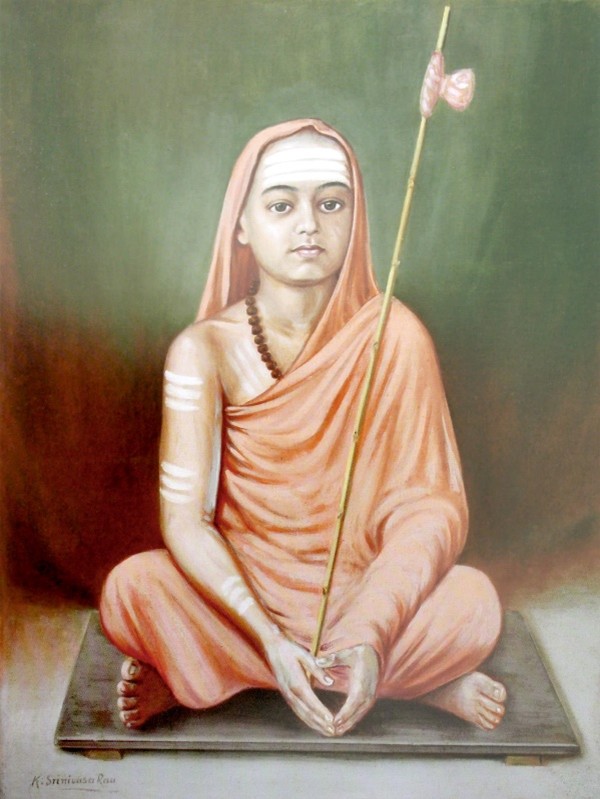
Adi Shankara was an intellectual giant, a genius of linguistics, and above all, a spiritual light and the pride of India. The level of wisdom and knowledge he showed at a very early age made him a shining light for humanity: Sadguru
Long time back, I read about an incidence. In an ongoing party in Germany, some Germans, followers of Adi Shankaracharya, were discussing about him. They had some unanswered questions. One of them said that Ambassador of India is also present in the party and he may throw some light on the subject. When these people approached and asked him, whether they could ask him some questions on Adi Sankracharya, they were shocked with the reply they got. The Ambassador said “Who is this bloke? I have not heard about him!”. Decades have passed, this incidence still remains fresh in my mind.
As was the Indian Ambassador, I am sure, majority of Indians remain ignorant of such a mammoth and divine personality, which I believe is a big tragedy.
Who was Adi Shankaracharya? He was a prodigal child and an extraordinary scholar with almost super human capabilities. At the age of two, he could fluently speak and write Sanskrit. At the age of four, he could recite all the Vedas, and at the age of eight, he took sanyas and left his home. Even at such a young age, he gathered disciples and walked throughout the country to re-establish the spiritual sciences. By the age of thirty-two, he left his body, but in those twenty four years, from the age of eight to thirty-two, he crisscrossed India a few times, north to south, east to west, from Kerala right up to Badrinath and back, travelling everywhere in all directions. In between he produced thousands of pages of literature.
He was born in Vaisakha Shukla Panchami, 509 BC in Kaladi, a small village in now Kerala, to Sivaguru and Aryamba. His parents, ardent devotees, prayed for a child to Shiva. It is said that in their dream, Shiva told them that he is going to take birth as their child and that is why they kept the child’s name Shankara.
Shankara lost his father at the age of seven. He wanted to become a Sannyasi. When Shankara broached the topic of his embracing the Sannyasa way of life, his mother was reluctant to give him her permission and blessings. One day, however, when he accompanied his mother for a bath in the river, a crocodile caught hold of his leg and started dragging him. His mother could only stand and watch helplessly. Then Shankara called out to his mother, asking her to permit him to become a Sannyasi at least during these last moments of his life. She agreed and miraculously the crocodile let go of Shankara’s leg. To console his mother he promised her that he would come back to her at the time of her death and perform the last rites.
Before he was eight, as a young Brahmachari, the young Shankara went to a house to beg for his daily food. The hostess was a kind but very poor lady. All she could give him was a small amalaki (goose-berry fruit). Shankara was deeply touched by the sincerity of this poor lady and he invoked Goddess Lakshmi (The Goddess of Wealth) by singing spontaneously the Kanakadhara Stotra. The legend has it that the Goddess showered golden amalaki fruits into the house.
He left home when he was eight. He embarked on a quest to find a Guru. Young Shankara journeyed at least 2000km before finally meeting his Guru, Govind Bhagavatpada. He stayed there serving his Guru for four years. Under Govind Bhagavatpada’s mentorship, Shankara delved into ‘Gaudapadiya Karika’, ‘Brahmasutra’, ‘Vedas’ and ‘Upanishads’. Shankara swiftly mastered nearly all the ancient texts, to his teacher’s astonishment.
At the age of twelve, his Guru deemed that Shankara was ready to write commentaries on major scriptural texts. At his Guru’s command, Shankara wrote commentaries elucidating the subtle meanings hidden in the teachings of the scriptures. At the age of sixteen, he dropped his pen having completed writing all the major treatises.
From the age of sixteen to thirty-two, Shankaracharya went forth, travelling across the length and breadth of ancient India bringing to the hearts of the masses the life-giving message of the Vedas: “Brahman, Pure Consciousness, is the Absolute Reality. The world is unreal. This is the correct understanding of the Sastra and is the thundering declaration of Vedanta”.

In those days, ancient India was sunk in a quagmire of superstitions and scriptural misinterpretations. Degraded ritualism flourished. The essence of Sanatana Dharma, with its all-embracing message of Love, Compassion and the Universality of Humankind was completely lost in the blind performance of these rituals.
Shankaracharya challenged various eminent scholars and leaders of various religious sects in vigorous debates (Shastrarth). They championed their own interpretations of the scriptures but the prodigious boy sage was easily able to overcome all of them and make them understand the wisdom of his teachings. These men of stature then accepted Shankaracharya as their guru.
They started to practice in accordance with his guidance, and this change in their lives also wrought a change in the lives of their innumerable followers, who came from all strata of society.
He established four Ashrams in four corners of India and entrusted his four disciples to teach and propagate Advaita through them.
In Shankara’s time, there were innumerable sects following their own narrow philosophies and systems of worship. People were totally blind to the underlying common basis of The One God. For their benefit, Shankaracharya formulated the six sect system of worship which brought to the fore the main godheads – Vishnu, Siva, Shakti, Muruka, Ganesha and Surya. He also formulated the rituals and rites to be followed in most of the major temples in India.
Apart from his immense intellectual and organisational capabilities, Shankaracharya was an exquisite poet, with a heart brimming with Love of the Divine.
He composed 72 devotional and meditative hymns like Soundarya Lahari, Sivananda Lahari, Nirvana Shalkam and Maneesha Panchakam. He also wrote 18 commentaries on the major scriptural texts including the Brahma Sutras, the Bhagavad Gita and 12 major Upanishads. He also authored 23 books on the fundamentals of the Advaita Vedanta philosophy which expound the principles of the non-dual Brahman. These include Viveka Chudamani, Atma Bodha, Vaakya Vritti, Upadesa Sahasri, among others.
Considered to be an incarnation of Lord Siva, Shri Shankara lived only a short life span of 32 years. There are inumerable inspiring legends about him.










 Ashok Chowdhary